English

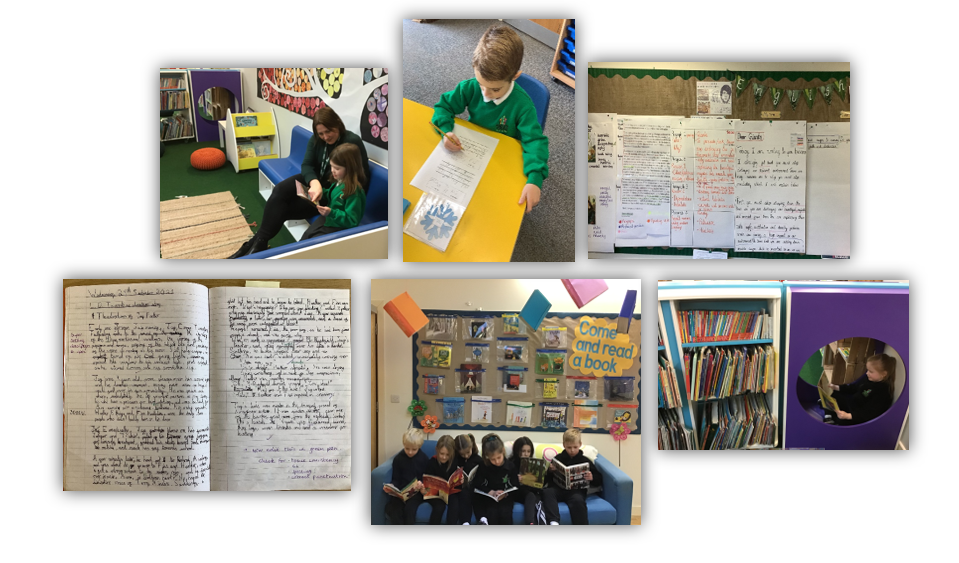
Writing is a life skill and, throughout their journey at Abbots Green Academy, we believe that every child should have the opportunity and support to become fluent, confident and skilled communicators, irrespective of their context or starting point. We are passionate about facilitating a purposeful and engaging writing curriculum so that there is a sense of achievement right from the foundation stage through to equipping our pupils with the essentials skills to use the written word confidently and eloquently by the time they leave primary school.
Writing underpins our whole curriculum; therefore we nurture opportunities to expose them to a rich and diverse range of experiences to challenge, deepen and apply their English skills and knowledge throughout the curriculum. Expert subject knowledge is carefully woven into each writing module which gives teachers the opportunity to teach and rehearse key knowledge and skills before applying this learning to meaningful extended outcomes. The careful architecture of this curriculum ensures that pupils build on prior learning and maximise purposeful curriculum connections to become writers for life.
Handwriting is taught using the programme Teach handwriting. Pupils learn pre-cursive handwriting in Year 1 moving to cursive handwriting in Year 2. In Key Stage 2, pupils continue to develop their speed, fluency and presentation of handwriting.
Reading
At our school, reading is recognised as a fundamental life skill and the gateway to success across the wider curriculum. Our ambitious and coherent reading curriculum ensures every child develops the knowledge, skills and confidence to become a fluent, independent and thoughtful reader.
A strong reading culture is woven throughout school life. Through high-quality texts, purposeful reading across the curriculum and a culture that celebrates books and storytelling, pupils develop positive reading habits and a genuine love of literature. Our aim is for every child at Abbots Green to become a ‘Whole Reader’ – skilled and knowledgeable, but also curious, reflective and motivated to read for pleasure and purpose.
Our approach interweaves phonics, fluency and comprehension as a connected and cumulative process. Pupils secure strong phonetical knowledge through systematic phonics teaching and targeted support, before developing accuracy, automaticity, expression and understanding through explicit fluency instruction and regular prosodic reading. Alongside this, pupils learn key comprehension strategies, including inference, summarising, prediction and evaluation.
Rich and ambitious vocabulary is developed through high-quality, challenging texts and explicit vocabulary instruction. Regular opportunities to read, respond, discuss, question and analyse enable pupils to think critically, articulate their ideas with precision and develop increasingly sophisticated comprehension skills.
Through a carefully designed literature spine and supplementary texts, pupils encounter diverse voices, cultures and perspectives. This broadens their understanding of history, societies and contemporary issues while deepening their appreciation of themes, ideas and authorial intent.
Robust assessment ensures pupils requiring additional support are identified quickly and receive targeted intervention to help them keep up with their peers. Through systematic teaching, high expectations and a culture that celebrates reading, every child is supported to leave Abbots Green as a competent, confident reader who understands the value of reading and is equipped with this essential life skill for the future.
Phonics
At Abbots Green we understand that systematic, synthetic phonics is the most effective way of teaching young children to read, developing the skills they need to tackle reading new words.
We follow the DfES Letters and Sounds programme to ensure consistency across the school as well as Jolly Phonic songs for mnemonics. In our Evergreen Nursery, in the Maple Room children focus on Phase 1 which concentrates on developing children’s speaking and listening skills and lays the foundations for the phonic work which starts in Phase 2 in the Oak Room and continues into Reception. The emphasis during Phase 1 is to get children attuned to the sounds around them and ready to begin developing oral blending and segmenting skills, prior to GPC.
In Reception, children are introduced to Phase 2 and 3 where they will develop GPC and segmenting and blending skills to decode words. During the summer term, children then move on to Phase 4.
In Key Stage 1, children move though Phases 4-6 ensuring that they master the alternative GPCs, can confidently decode more complex words, develop their fluency and can apply rules for spelling.
Phonics is taught in daily discrete lessons and we have a shared approach across Reception and KS1 in the teaching of phonics. We firmly believe that for Phonics to be most effective, it must be embedded across all areas of the curriculum and strive to make links wherever possible. We are committed to ensuring that all children become fluent readers by the end of Key Stage One. At the end of Year 1, children undertake a national phonics check. For more information about phonics please visit https://www.readwithphonics.com/parents-phonics-guide.
We offer parent information sessions throughout the year.